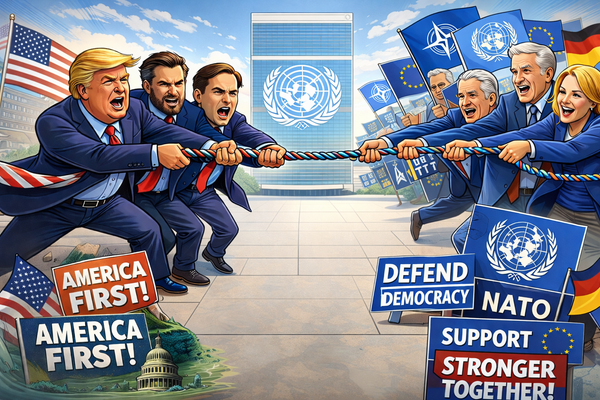
The Case for Global Institutions
Global Governance  ·  Data Dashboard  ·  2024–2026

The Case for Global Institutions

Why the world needs them, why trust is collapsing, and what reform must look like

58%
Trust in UN 2024
Down from 65% in 2021
39%
Trust in Nat'l Govts
OECD 2023 survey
193
UN Member States
Up from 51 in 1945
40%→5%
Global Tariffs
GATT/WTO 1947–2024
17.4%
US IMF Vote Share
vs 6.4% for China
80 yrs
No Great-Power War
Since UN founded 1945

The Trust Collapse — By The Numbers

Source: Edelman Trust Barometer 2017–2024 · OECD Trust Survey 2023

Global Trust in Key Institutions (% expressing trust) 2017–2024

Why Trust Has Collapsed

% citing as major factor · Synthesis: GlobeScan, OECD, Edelman

How Trust Can Be Rebuilt

Estimated effectiveness · Based on OECD governance research

Who Actually Runs These Institutions?

Source: IMF Quota Data 2024 · Atlantic Council · UN Membership Records

IMF Voting Power (Actual %) vs GDP Share (%) — The Mismatch

China's calculated quota share (13.7%) is more than double its actual voting share (6.4%). Africa — 54 nations, most IMF borrowers — holds just 6.5% of votes.

UN Security Council Permanent Members — Frozen in 1945

The gap: India (1.4B people, $3.7T GDP), Brazil, Nigeria, Germany and Japan all have stronger modern cases for permanent membership — yet have no seat.

UN Membership Growth — From Western Club to Near-Universal

UN grew from 51 founding members in 1945 to 193 today — driven by decolonisation in the 1960s and post-Soviet expansion in the 1990s.

What Global Institutions Have Actually Achieved

Tracking real-world outcomes since 1945

Global Average Import Tariffs — The WTO/GATT Effect (1947–2024)

Average tariffs fell from ~40% in 1947 to ~5% today — enabling the global trade that lifted hundreds of millions out of poverty.

The Reform Agenda — What Needs to Change

Urgency, difficulty, and impact of key institutional reforms

Key Reforms: Urgency vs Difficulty vs Potential Impact (0–100)

Institutions We Still Need to Build

Why Western Powers Must Accept Reform

The Problems That Demand Global Institutions

Problems physically impossible to solve without global coordination

Can One Nation Solve This Alone? (% solvable without global coordination)

The Network Effect: More Members = More Power

Governed vs Ungoverned Interdependence

With Institutions
✓ Coordination on shared threats
✓ Rules constraining the powerful
✓ Peaceful dispute resolution
✓ Shared early warning systems
✓ Collective crisis response
Without Institutions
✗ Raw power fills every vacuum
✗ The strongest set the rules
✗ Conflict as dispute mechanism
✗ Pandemics spread unchecked
✗ Race to the bottom on standards
“We are already deeply interconnected. The only question is whether we manage that interdependence through rules and cooperation — or through raw power.”